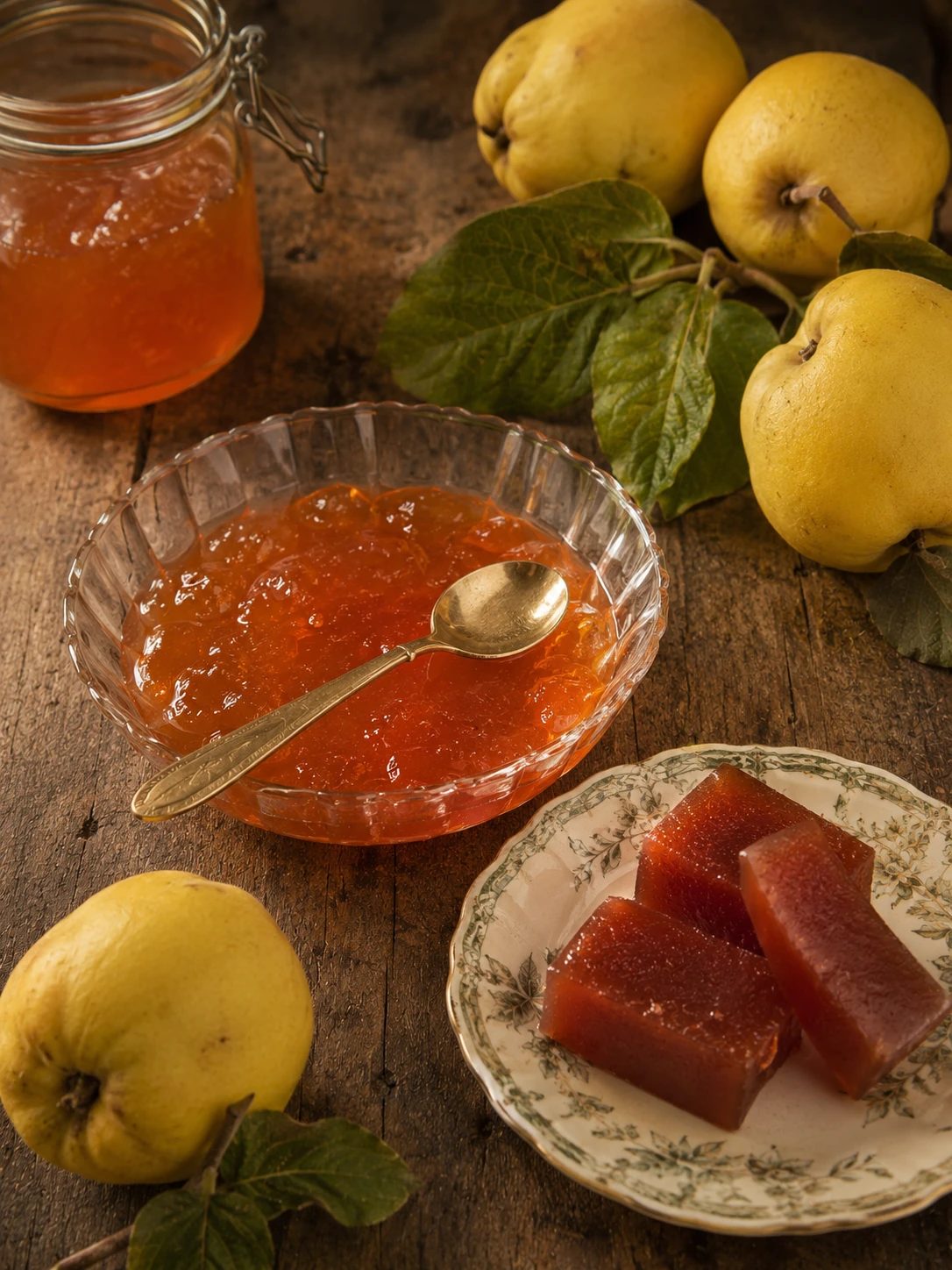
Quince may be the most efficient fruit there is, since a single batch gives you three completely different things worth having, with almost nothing wasted along the way.
The fruit's own history is suitably grand. Quince is native to the Caucasus, and the Greeks considered it sacred to Aphrodite, the fruit behind the golden apple that Paris awarded her, the one that ultimately sparked the Trojan War. Newlyweds in ancient Greece ate a slice before entering the marriage bed, and the Romans continued the tradition, depicting Venus holding a quince in her hand. Centuries later, quince paste travelled from Portugal into English as marmelada, and gave the word marmalade its name, long before oranges had anything to do with it.
Quince is genuinely prolific to work with. Take six to eight quinces, cut in half so they cook down quickly, and run them through a steam juice extractor, the kind with three stacked sections, boiling water at the bottom, a juice collector in the middle with its own small spout, and the fruit sitting on top. The steam rises up through the fruit, and as it cooks, the juice drips straight down into the collector below, leaving the cooked fruit up top and a perfectly clear juice in the middle, no pressing, no straining, nothing cloudy about it. The juice itself comes out looking almost like liquid gold, a deep golden red depending on the variety.
Weigh the juice and add a kilo of sugar for every kilo of juice. Cook until it comes to a gentle, steady bubble. Scum may rise to the surface, take it off with a strainer as you go if you like a completely clear jelly, though a little left behind won't ruin it, just risks a slightly bitter top layer once potted. Some cooks stir in a knob of butter to break the scum down instead of skimming it off, either approach works. Once it's bubbling steadily, add pectin to suit the jelly's needs and the fruit's own weight, less if you like a softer set, more if, like this one, you prefer it properly firm. Boil as long as required, then pot.
The pulp left behind in the extractor still has plenty to give. Push it through a vegetable press to remove the skin and the hard core, and what's left is a rosy, smooth pulp. From here you choose your direction: pot it as a soft, spreadable jam, or take it further into a paste, which in several countries is served alongside cheese, though it's just as good on breakfast bread. If you're making the paste, take care as it cooks, a single hot drop is like lava, and it genuinely burns if it pops onto skin.
Vanilla is a good addition to the pulp either way. You'll need sugar regardless of which direction you take it, and pectin again here helps avoid overcooking the fruit any longer than necessary. Some batches get oat flakes, raisins, and crushed nuts stirred through instead, turned into proper energy bars rather than a jam or paste at all.
Once it's cooked, and it will be thick, hard to stir, and extremely hot, lay it out on a tray lined with paper to dry slightly, then cut into bars once cool. Or simply pour it into an aluminium or plastic container with a lid, let it cool fully, and store it in the fridge, where it will keep for months, drying out a little further over time. If you have a dehydrator, you can take it further still, cutting the dried paste into strips or cubes and rolling them in sugar for homemade fruit bonbons. Both versions are worth having. A splash of lemon at the very end of cooking gives either one a little extra tang if you want it.
From a single kilo of raw quince, between the jelly, the jam, the paste, and whatever else you turn the leftovers into, you end up with a genuinely surprising amount to show for it.